WSG alumna focussed on resolving SDGs using her platforms
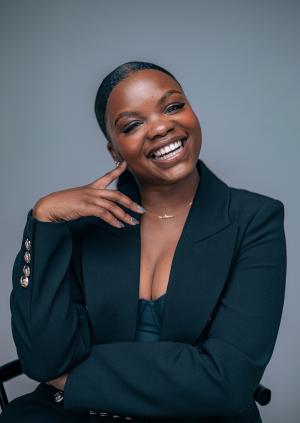
Yonela Nomalizo Ntshakaza, a changemaker in South Africa was recently recognised as one of the Mail & Guardian's Top 200 Young South Africans for 2026. This WSG alumna graduated from the Wits School of Governance (WSG) December 2025, with a Postgraduate Diploma in Management qualification, which she completed in 2024.
Tell us about the defining moment or experience that made you realise you wanted to dedicate your career to the public sector and/or serving society?
It happened during my articles at the Auditor-General of South Africa. I was deeply moved by the corruption I saw and I knew I wanted to make a tangible difference in fighting it. But I also knew there are socio-economic challenges that keep young people out of quality employment and we all know how high our unemployment rate is.
Small and medium enterprises (SMEs) are the bedrock of the South African economy and I realised I wanted to be part of that. So I pivoted from the public sector into the private sector, because that is where my impact could be more measurable and tangible. I now help SMEs access funding and skills. I am also a literacy advocate through my social media platforms. Studying at the Wits School of Governance (WSG) gave me the grounding to do all of this with a deeper understanding of how the state works.
Conscious leadership requires continuous unlearning and relearning. How has your time at WSG shifted your perspective on how you can create actual, tangible impact in your work?
When I started my qualification at WSG, I was unemployed. I self-funded my studies and only graduated a year later, and it is the best thing I have ever done for myself. Having my qualification from Africa's leading school of governance set me apart and it still opens doors for me.
WSG gave me practical frameworks to measure impact through Monitoring and Evaluation and Development studies taught me to look at the qualitative side as well. It helped me quantify and measure impact, but it also taught me that impact is nuanced and layered, especially in South Africa.
I use this every day. As Programme Delivery Manager at Edge Growth, I run Enterprise Supplier Development programmes that get SMEs investment-ready and linked to funding and market access, and I measure what changes for them. My work is in the private sector, but the impact reaches far beyond it. A number on a report does not always tell you what changed in someone's life and WSG taught me that.
You are passionate about using social media for good. How are you using these platforms to influence mindsets or drive actual behavioural change in your community?
I use my platforms to show young people that social media can be used for more than entertainment. My focus is on reading and literacy, and on showing that when it is done right, reading does not have to be hard.
I also ran segments where I shared what I was learning at WSG with my reading community. I broke policies down so they made sense, and I spoke about why voting matters. In 2024, I volunteered through WSG as an elections observer, and I used my platform to share books that help young South Africans make informed decisions when they vote.
I reviewed a book co-authored by Professor Mills Soko of Wits Business School, whose work is important in the Wits community. Head of the WSG, Professor Themba Maseko wrote For My Country. Both have informed how I think about ethics and having a moral compass, especially for anyone who wants to work in service of society. Reading For My Country reminded me that doing the right thing can cost you, and that this is exactly why it matters. Being named one of the Mail & Guardian's Top 200 Young South Africans for 2026 showed me that this work is landing with people.
If you could change one specific mindset or behaviour among young South Africans regarding how they view governance and public policy, what would it be and why?
I would change how young South Africans feel about governance and public policy, especially the indifference about state affairs. It affects us much more than we realise.
We need young people to be proactive about educating themselves on governance and public policy, because it decides our future. If we did that, we would take our votes more seriously. With the local government elections on 4 November next month, it means we can go in and make informed decisions. The future of this country depends on us, and we have to be part of the conversation. WSG showed me how much of what happens in our country comes down to how it is governed.
Looking beyond just a job title, what is the ultimate societal problem you are trying to solve? How does your career serve a purpose larger than yourself?
I am trying to solve unemployment and illiteracy, which I believe are directly linked. They speak to two of the Sustainable Development Goals: SDG 4, Quality Education and SDG 8, Decent Work and Economic Growth.
In 2023, it was reported that 80% of Grade 4 learners cannot read for meaning. If a child cannot read, they cannot learn, and if they cannot learn, they struggle to compete for work later in life. Our unemployment rate keeps going up, and I do not think we can fix one without the other. It starts in the classroom and it ends in the economy.
My career in SME development and the ESD space speaks to the SDG 8 side of this. SMEs are the bedrock of our economy, and when we help entrepreneurs access funding, skills and markets, they scale and create more jobs.
Through my literacy work on Booked and Being, I speak to the SDG 4 side: making reading popular again, so that the next generation is ready for those jobs. But it is also for people who cannot find a job and are curious about starting a business. I want them to know you can start by solving a problem. On the Booked and Being podcast, I will have founders who have scaled their businesses share what that journey looks like and how to become investor ready, so that learning is available to anyone who wants it, not only people in the room.
WSG taught me to look at problems like this through a governance and public policy lens. It showed me that these challenges will not be solved by one sector alone. It takes the state, the private and public sector as well as communities working together. That is bigger than my job title. It is about young South Africans having a real chance to learn, work and build a life.
Being recognised as a brilliant young South African is a powerful platform. How do you plan to use this recognition to uplift others or advocate for more conscious leadership in our country?
I plan to use my recognition to open doors for other young people. I know what it is like to start with nothing. I started my platform when I was unemployed, without a good camera or mic, and I started at WSG the same way, funding it myself. So I want to give young founders and authors space on my podcast, Booked and Being, to tell their stories.
I will keep using my platforms to push literacy and to make governance easier to understand for people my age. I also want to come back to WSG and share what I have learnt with current students. If you are thinking about studying while things are uncertain, WSG is worth the investment.
Related Articles